How 3D Artists Are Using AI: An Expert’s Workflow
How To, Insights | Published on
5 min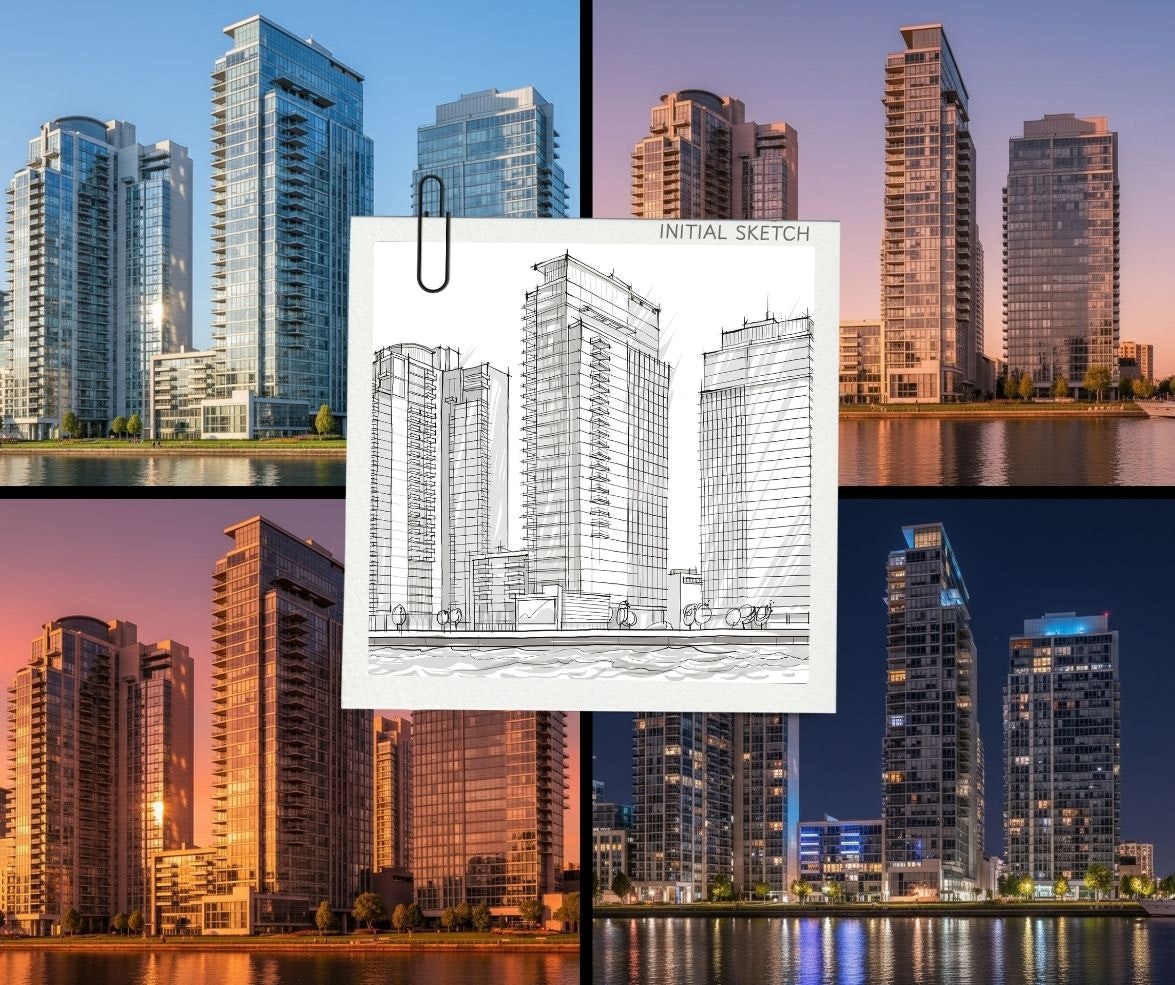
The 3D domain has recently seen the rise of the hybrid artist, a creator who blends the precision and control of traditional 3D software with the speed and exploratory power of AI. This isn’t a workflow that replaces foundational skills. It’s one that amplifies them, freeing artists from repetitive tasks to focus more on creative direction and storytelling.
To show you what this looks like in practice, we spoke with Maurizio Gastoni, a visual architect and 3D artist who has built his workflow around this hybrid approach. He uses AI not to replace his artistic judgment, but to enhance it, allowing him to explore new creative directions and deliver better results for his clients with greater speed and efficiency.
From Traditional Rendering to AI-Enhanced Art
Before AI, the traditional 3D pipeline was a slow, linear process. Artists would spend days or even weeks on a single image, texturing, lighting, and finally, the long wait for a final render.
This workflow was precise, but its rigidity made creative exploration difficult and time-consuming. Any significant change meant going back to the beginning, a costly bottleneck that many artists know all too well.
This is a challenge Maurizio understood well. With a background in architecture, he was drawn to 3D visualization because he loved the “quick feedback loop” it offered compared to the slow pace of architectural projects. He wanted to create and iterate on visuals quickly, a desire that eventually led him to explore AI.
His first experiments with AI image generators were interesting but ultimately limited for professional work. The outputs were unpredictable, lacking the fine-grained control needed to meet specific client demands. The turning point came with the introduction of technologies like ControlNet.
“Things became interesting with the introduction of ControlNet. That level of control allowed me to bend the rules of visualization and opened up entirely new possibilities.“
Suddenly, artists could guide the AI using their own 3D models, using depth maps and line art to direct the composition with precision. This gave Maurizio the control he needed, transforming AI into a creative partner.
Maurizio’s Hybrid 3D Art Workflow
Maurizio’s process provides a clear blueprint for the hybrid workflow. His core philosophy is simple but powerful: the client’s main subject, the core of the design, always remains under his direct, manual control. He then uses AI to build the world around it, taking advantage of its speed to explore context, atmosphere, and narrative elements that bring the final image to life.
“The core design always stays intact, while AI is used for context, atmosphere, and storytelling elements that help “sell” the image.“
This approach is broken down into three distinct phases.
Phase 1: AI-Powered Concepting & Moodboarding
The first phase is all about creative exploration. Instead of spending days creating manual sketches or moodboards, Maurizio uses AI to rapidly test different creative directions. He takes the client’s 3D model and generates dozens of variations, exploring different lighting conditions, moods, and environmental contexts to see what resonates best.
Source: Maurizio’s personal archive.
For this ideation stage, he turns to platforms like Leonardo.Ai for its powerful mood generation capabilities. This allows him to present a wide range of visual concepts to a client in a fraction of the time it would traditionally take, getting alignment on a creative direction much faster.
Phase 2: AI-Assisted Execution
Once a direction is chosen, Maurizio moves into execution. He starts by creating a 3D blockout of the scene in traditional software to establish the core composition and lighting. This 3D scene then becomes the geometric guide for the AI.
Using its depth map and line art, he directs the AI to generate a final, highly detailed image that matches his intended structure.
The efficiency gain here is significant. What once took days of painstaking manual detailing, like texturing environments or adding background elements, can now be achieved in a matter of hours.
Phase 3: AI-Driven Post-Production & Refinement
The final phase is about polishing the render to perfection. This involves using AI for fine-tuning tasks like fixing small errors with inpainting or upscaling the image to a high resolution for final delivery.
To achieve a flawless final result, Maurizio uses tools within Leonardo.Ai for its high-quality upscaling and versatile image-to-image workflows. This allows him to make precise adjustments and ensure the final output meets the highest professional standards.
The 3D Artist’s New Role: From Technician to Creative Director
This new hybrid workflow does more than just speed up production. As Maurizio sees it, the role of the 3D artist is evolving:
“I believe the role of the 3D artist will evolve from execution-heavy to concept-driven, where the main value lies in curation, taste, and narrative rather than raw technical production.“
In this new paradigm, the artist’s most critical skills are no longer just about technical mastery of software. Instead, they are about providing the vision that AI cannot. With AI handling much of the “how,” the artist is freed to focus more on the “why.”
The human touch becomes the final, indispensable layer of quality control, ensuring the work is not just technically proficient but also creatively compelling.
Maurizio’s Advice for Integrating AI into Your 3D Art Workflow
For artists looking to start integrating AI into their own work, Maurizio offers some practical advice based on his experience. His approach is about strategic adoption, not total replacement, ensuring the artist always remains in creative control:
- Start with secondary elements. Don’t try to replace your entire workflow at once. Maurizio suggests using AI for things like backgrounds, atmospheric effects, or initial concepts. Keep your main subject, the core of your design, under your direct manual control.
- Treat AI as a collaborator. Shift your mindset from viewing AI as a replacement for your skills to seeing it as a creative partner. Use it to explore unexpected ideas and new directions that you might not have considered otherwise.
- You are the final judge. While AI is great for generating options, your artistic eye is what ultimately ensures quality. Don’t be afraid to experiment and let the AI surprise you, but always remember that you are the one making the final call on what serves the creative vision.
Final Thoughts
The shift to a hybrid workflow marks a fundamental evolution in 3D art. This new paradigm doesn’t diminish the role of the 3D artist. On the contrary, it amplifies it. By automating repetitive technical tasks, AI frees creators to focus on the skills that truly define their craft: art direction, storytelling, and the creative vision that brings a project to life.
AI is not here to replace your skills, but to enhance them. By embracing these tools, you can spend less time on the grind and more time on what you do best: creating incredible work that pushes the boundaries of imagination.
“Treat AI as a collaborator rather than a replacement. Also, don’t be afraid to experiment: the strength of AI is in opening unexpected directions, but the final judgment must come from you as an artist.“
RelatedArticles
How to Add AI Music and Voiceovers to Your Videos
Silent AI videos lose viewers fast. Here are three ways to add sound in Leonardo.Ai — video models with native synced audio, custom soundtracks with Music v1, and AI voiceover with Seed Audio 1.0 — plus a step-by-step walkthrough.
remove.bg API is Moving to Leonardo.Ai
remove.bg's background removal API has joined Leonardo.Ai, also part of Canva. Everything you do today with the remove.bg API, you can do on Leonardo, plus upscaling, scene generation, and more.
The 6 Best Google Flow Alternatives to Try (Free & Paid)
Google Flow puts Veo 3.1 in a slick AI filmmaking studio, but its credit system is steep, allowances don't stretch far, and you're limited to Google's own models. Here are the six best Google Flow alternatives, including options that offer Veo itself alongside the rest of the latest state of the art video models.
ImagineArt vs Leonardo.Ai: Features, Price & Performance Compared
ImagineArt and Leonardo.Ai look similar at first glance: both put a collection of AI image and video models behind one interface. The differences show up in what surrounds those models — creative control, editing workflow, 3D and audio generation, team features, and pricing. Here's how the two platforms actually compare.